Linear vs Lotus: One Organizes Bugs. The Other Fixes Them.
In this article
Linear is good at what it does. That's actually the problem.
You get a clean interface, a beautiful backlog, color-coded priorities, and a clear view of every bug your users are experiencing. Then someone needs to fix those bugs. That's where Linear stops and your engineering team starts.
Lotus starts where Linear ends.
When a bug hits production, Lotus detects it, reads your codebase, and surfaces a prioritized suggestion with full context. Your team fixes it manually or triggers Claude to automate the correction. Either way, the workflow that Linear turns into a well-organized ticket, Lotus turns into a resolved issue.
The Tool Categories Are Different
It sounds obvious when you say it out loud: Linear is a project management tool. Lotus is a bug intelligence and resolution layer. But founders and engineering leads spend years conflating the two, looking for a single tool that does both, and ending up with a polished backlog and a product that still breaks.
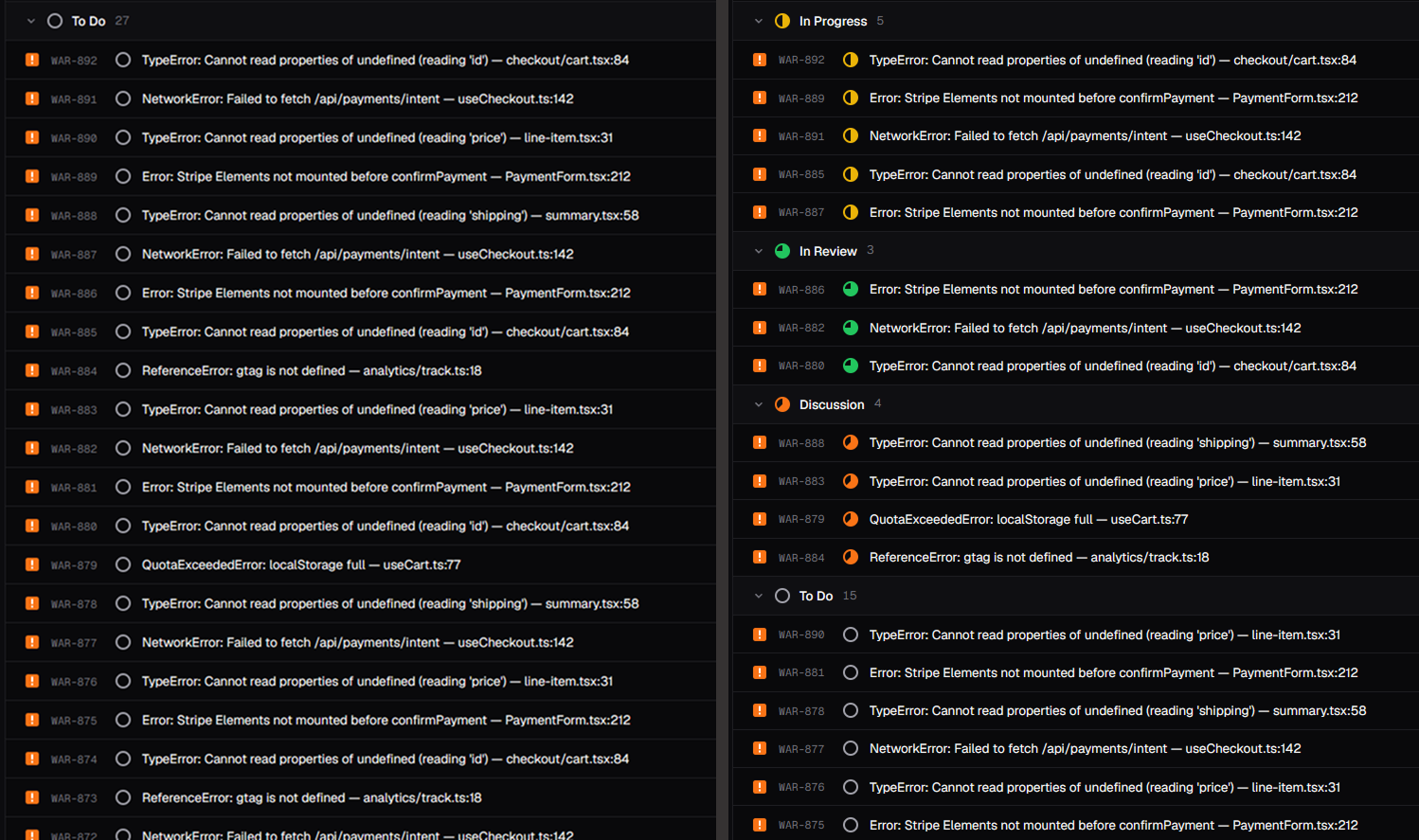
Linear does not know what your code looks like. It can't read a stack trace and propose a solution. It surfaces the ticket. The label, the priority, the assignee. Your engineers open the ticket, read the description, dig into the codebase, write a fix, test it, push it, get it reviewed. Linear records all of that beautifully.
The problem isn't the recording. The problem is the time between "bug detected" and "bug fixed" and everything that happens to your users during that window.
What an Unresolved Bug Actually Costs
A bug that sits in your backlog for four days isn't just a product issue. It's a quiet churn machine.
Users who hit a broken flow once tend to try again. Users who hit it twice start looking for alternatives. They don't file a support ticket explaining why they're leaving. They just stop logging in. By the time the issue shows up in your churn report, the damage has been compounding for weeks.
This is the math that makes backlog debt so expensive for early-stage SaaS teams. One unfixed bug isn't one user lost. It's every user who runs into that specific flow, across every session, until someone on your team finally ships the fix. And on a small engineering team with limited sprint capacity, "finally ships" might mean two weeks from now.
Linear helps you see the bug clearly. Lotus makes sure the window between detection and fix is measured in hours, not sprints.
How Lotus Actually Works
Lotus monitors your production environment in real time via an SDK you install in under 60 seconds. When it detects an error, it does not create a ticket and wait. It reads your repository, understands the context around the failure, and surfaces a prioritized suggestion with the relevant code context already attached.
From there, your team has two paths. Fix it manually with everything Lotus surfaced already in front of you: the error, the affected code, the suggested approach. Or trigger Claude directly from Lotus to generate the fix automatically, review the output, and merge it. The second path compresses what would normally take hours into minutes, without removing your team from the decision.
The same process applies to feature requests and user feedback. Lotus collects signals from multiple sources, groups duplicate reports, and ranks them by actual impact on retention and revenue. Your team always knows what to work on next and already has the context to act.
The Workflow Side by Side
With Linear, a typical bug resolution looks like this: error fires in production, user or monitoring tool catches it, someone creates a ticket, ticket gets triaged and prioritized, lands in the next sprint, gets assigned, engineer investigates, writes a fix, opens a PR, PR gets reviewed, fix gets merged. Fastest realistic version of that cycle for a small team: two to three days. Realistic average: four to seven days.
With Lotus: error fires in production, Lotus detects it via SDK and surfaces it with full context, your team reviews the suggestion and either fixes manually or uses Claude to generate the correction, reviews the output, and merges. Total time from detection to resolution: under a few hours for most issues, with no context-switching or investigation overhead.
For a team shipping fast and iterating on feedback, that compression changes how you think about your backlog entirely. Issues don't accumulate. They close.
Pricing in Context
Linear charges per seat. At $8/seat/month, a 10-person engineering team pays $80/month for organized work. Linear Plus adds more features at $16/seat/month.
Lotus starts at $29/month for the Pro plan with no per-seat pricing. That covers 50 AI-assisted resolutions and 5 projects, with unlimited team members. The Team plan at $99/month covers 200 resolutions and unlimited projects.
The comparison that matters isn't the subscription cost. It's the cost of the engineering time Linear doesn't replace.
If Lotus helps your team close 50 issues in a month that would have each required two hours of investigation and context-gathering, that's 100 hours of senior developer attention redirected to product work. At $150/hour for a mid-market SaaS engineer, $29/month is not a tool cost. It's a return.
Integrations and Setup
Linear integrates with Slack, GitHub, Figma, Sentry, and most of the standard SaaS stack. It's well-supported and the integration ecosystem is one of its genuine strengths.
Lotus integrates primarily with GitHub and connects to Claude for automated corrections. Setup is SDK installation plus repository connection, running in under 60 seconds. The integration surface is narrower by design. Lotus doesn't need to know about your Figma files or your sprint ceremonies. It needs to know about your codebase and your error signals.
If your team's existing workflow is built around Linear's project management layer, Lotus doesn't replace that. It operates underneath it. Linear handles the product coordination layer. Lotus handles the detection, prioritization, and resolution of bugs and issues. You get the visibility Linear provides and the throughput Lotus delivers.
Who Should Use What
Linear is the right choice if your team needs cross-functional visibility, sprint planning, and project coordination across multiple workstreams. It earns its place in teams where the bottleneck is communication and alignment, not execution speed.
Lotus is the right choice if your backlog is a product liability. If bugs are contributing to churn, if feature requests sit untouched for weeks, if your engineers spend more time on maintenance work than on new product surface — Lotus was built specifically for that problem.
The two tools are not competing for the same job. But if you're a small engineering team choosing where to put your investment, the question worth asking is this: does your product move faster when work gets organized, or when it gets done?